The Thing I Couldn’t Stand in My Partner Was In Me All Along
Our next True Contact weekend is November 7–8 in Boulder. Here is why we teach it.
Our next True Contact weekend intensive is November 7–8 in Boulder, and applications are open. Twelve spots. Apply here.
No matter how many times I do the dyad practice we teach there, it still blows me away.
The biggest ruptures with Kiki have become the biggest breakthroughs when I see through the illusion that she is the problem and reclaim whatever I’ve been projecting onto her.
Most recently, it’s been entitlement. I could not stand it in our relationship.
Anything that felt like a demand or an expectation, even over a household chore being done or the house being tidier, I wanted nothing to do with. A demand felt like entitlement to me: thinking that we owed each other something rather than having the thing freely given.
Any time she showed even a whiff of what I experienced as entitlement, I rejected it.
The breakthrough came in our dyad practice last week. The form is simple. Two people. One goes directly into their own material. The other meets them with presence and physical contact, through the arms, pushing and pulling, following what the body is feeling underneath all the story. Charge moves because it’s finally met.
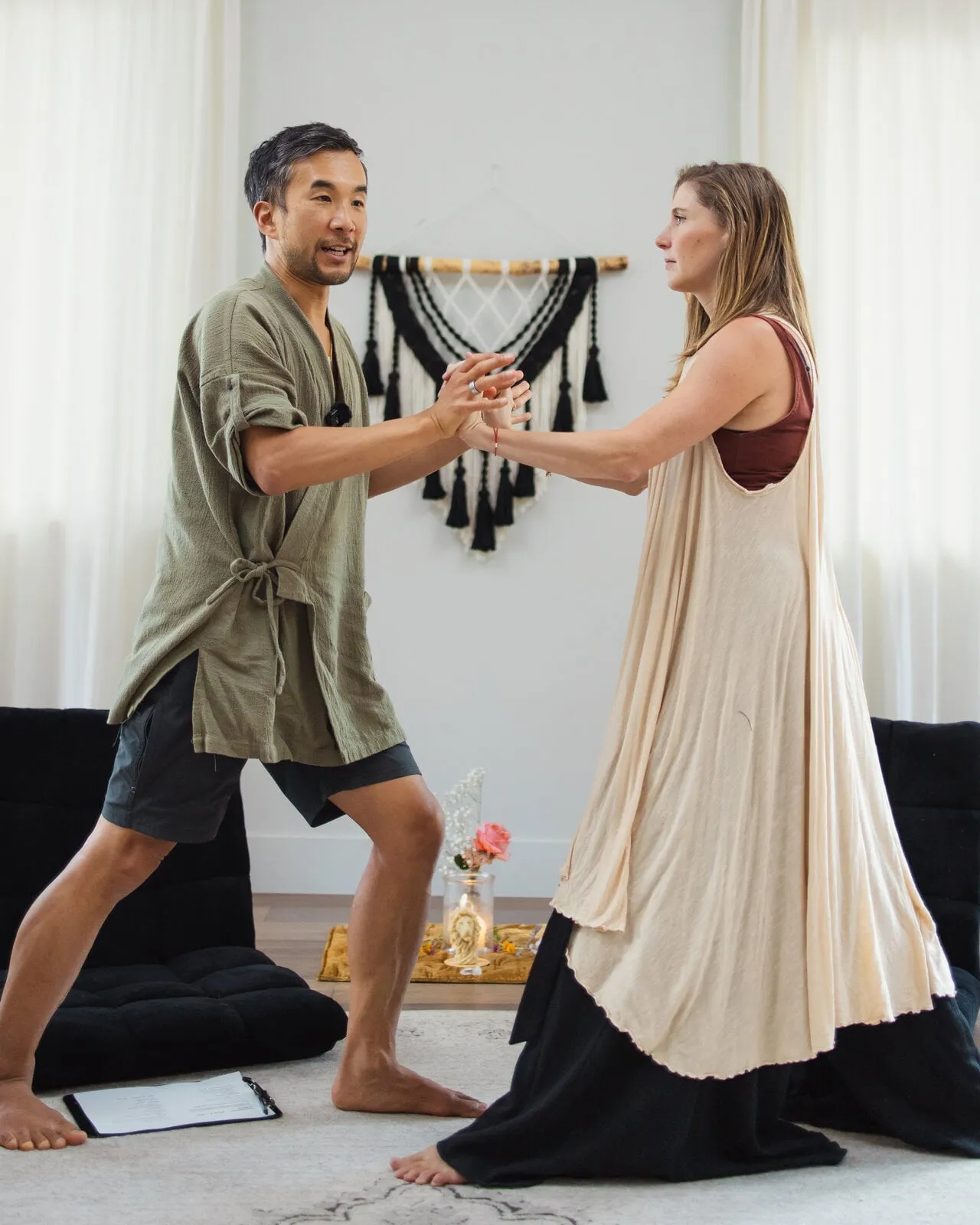
After I moved my anger, my frustration, and my heartbreak into the ocean of love that she was holding in the practice, I could finally see it. I had rejected the entitled place in myself.
There’s a place in me that’s clung to the story of being from an immigrant family. My parents worked 364 days a year in our family store in San Francisco Chinatown so that we could all survive. Growing up, my siblings and I did our homework and then gathered in the living room in the evenings to package herbs for the family business.
The story is that we worked hard for everything we have, and that now we need to appreciate it.
Of course, there is truth in that story.
And there is also truth that life has been so good to us and has brought us to a level of abundance that no version of my younger self could have ever imagined. Almost every day Kiki and I look at our daughter Ember who’s turning two, then into each other’s eyes, and tear up at the beautiful life we are living.
And that is where I found my own sense of entitlement, in the story of “I worked hard for this and therefore I deserve it.” As if life owed me this, rather than gave it freely.
Until I reclaimed just how entitled my own life has been, until I loved that place, I couldn’t love the same place in her.
Here is the ripple after the practice I didn’t expect and that is still revealing itself. If I was afraid of ever appearing entitled, it would only be natural to be shy about fully claiming what I truly wanted, for fear of being judged that way. And so, avoiding that part of myself meant missing a deeper contact with what is actually true for me.
On the other side of that practice, I can feel it deepening my clarity in my partnership, in our sex life, in my relationships, and in the work unfolding through the school.
This is what it has to do with attachment. A place in me that I reject is a place that never felt loved. As a child I remember hearing words like, “Finish your rice. There are starving children in China.” Not appreciating what I had been given counted as entitlement, and entitlement got shamed instead of loved.
The dyad practice we now live and teach is where core attachment imprints get repaired: in the body, in relationship. When someone meets that place with presence and contact, and it doesn’t have to go away, our nervous systems learn that it can be included. That’s what secure attachment means. I am safe and loved to be all parts of me. Nothing in me has to be split off and rejected.
That is the power of this practice, and why it still blows me away. What happened between Kiki and me is just one version of it.
What this practice touches goes far beyond partnership:
- Your finances, and the instability you feel when you look at them.
- Your desires in sex, and the fear that comes up around truly owning them.
- Your health, and the spirals of worry that happen when something feels off.
- What you’re here to do with your life, and the existential searching around it.
- Tension in your dating life, and the anxious or avoidant wobble that follows.
In each one, there is a thing that happened, and there is your relationship to it. The thing is just the thing. The relationship is shaped by an attachment imprint. And whenever that relationship is anything less than an unconditional trust that you are loved and okay, this practice can meet it at its root.
Because underneath each one is the same question: is Life still holding me, even in this? This practice gives our nervous system a new imprint: Life unconditionally holding us in the places where we think love or safety goes away. That’s secure attachment with Life, a felt trust that there is nothing life can show us that we can’t meet.
This is why we teach it.
This summer, we taught it to our founding cohort of True Contact, and to a weekend of new parents (and their babies), and every person in the room came with their own place yearning to be met.
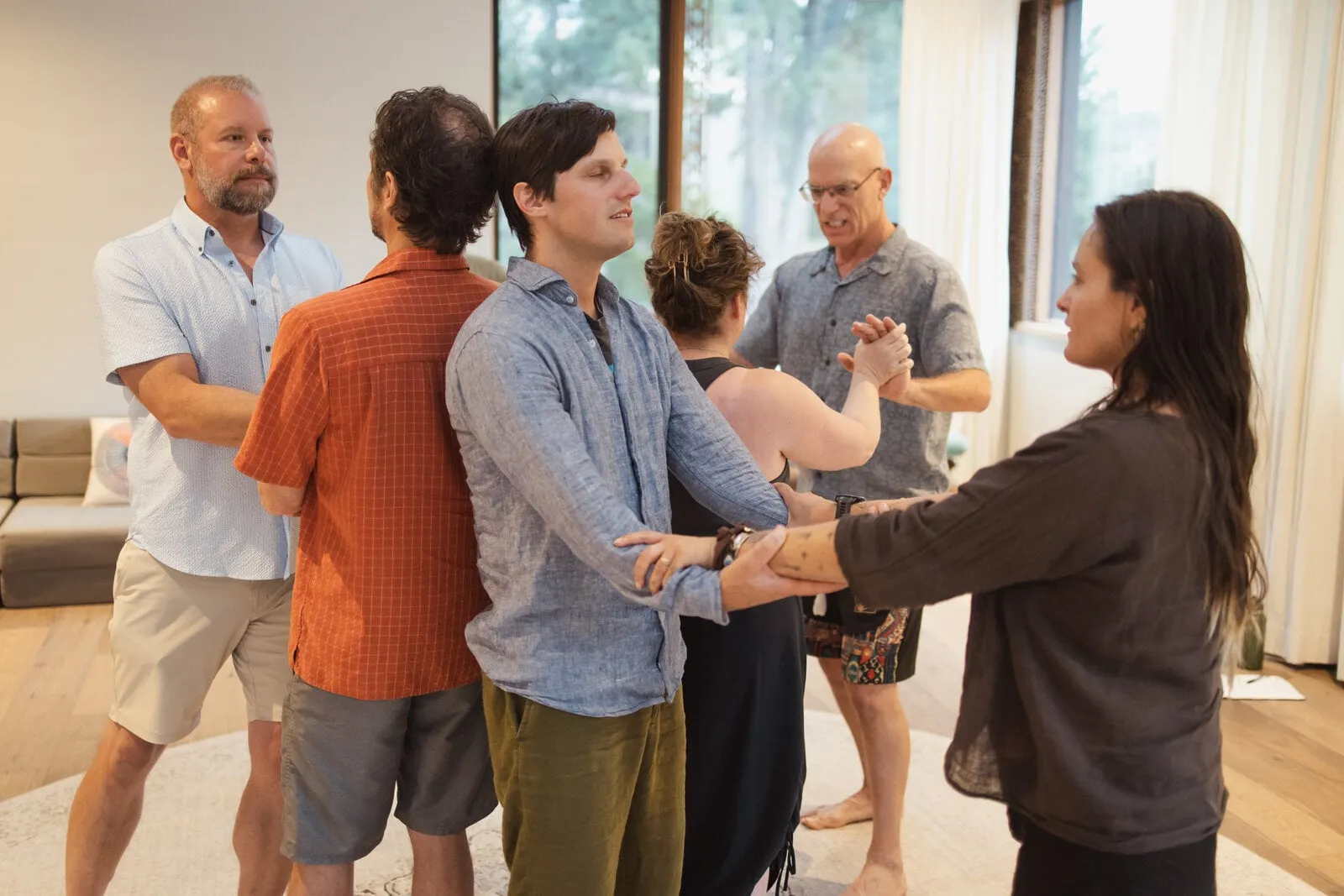
Here is what they found.
I’ve been a person who has been on a healing journey for decades, and I’ve tried everything that I could try. This is the first thing that has felt like a shortcut to go right to the heart of the matter of what’s going on. I’ve touched things in my core material that I’ve never touched before, things that medicine journeys and weekend retreats and all these different modalities haven’t shifted. Those were great mountaintop experiences, but this is the first thing that feels like something foundational is shifting.
— Tom Marbois, founding cohort
I’m getting to work on the most challenging parts that I have hidden for my whole fifty years of life, from that earliest time where I wasn’t met, I wasn’t held emotionally, I wasn’t seen. I’m being met in this moment with this grief and shame. And in that, there was such a liberation. I didn’t have to hide it, and I didn’t have to use anger and frustration to push it away. I just got to sit in that softness and vulnerability.
— Shannon Hoppenstedt, founding cohort
In the intensity of postpartum, our connection had taken a backseat and there was so much between us we hadn’t had the space to actually repair. Kiki and Edmond, along with their amazing support team, created such a safe, attuned container that we were able to meet each other again, heal long-overdue ruptures, and access a depth of connection I honestly hadn’t felt between us in a long time. We left softer, closer, and with an actual practice for meeting rupture in everyday life.
— Chelsey Lehl, with her partner, at the last intensive
Each of them came with something that they’d been carrying for a long time. That is all you need to bring — whatever is here for you so that we can truly make contact.
Announcing the next True Contact
Our upcoming True Contact is a weekend intensive on Saturday and Sunday, November 7–8, from 10am to 5pm, in person in Boulder.
Over two full days you will use the dyad practice to meet your own core attachment material. You bring home an embodied and relational practice that can turn secure attachment into a way of life.
You will:
- Discover how something that feels like a problem outside of you can be worked with inside your body.
- Reclaim the energy you spend needing another person—or Life—to be different.
- Find what’s actually asking to be met underneath the words and stories—in your own body and others.
- Resolve patterns that insight, solo practices, and medicine journeys often can’t touch.
- Discover how to turn ordinary moments—in relationship, parenting, work, desire, grief, and uncertainty—into opportunities to deepen secure attachment with Life.
- Open to new levels of joy, grief, anger, desire, and aliveness without needing the intensity to go away or be managed.
- Feel in your body what it’s like to unconditionally trust that Life is holding you, no matter what.
There are twelve spots. Come by yourself or with a partner.